

A decorative glass bulb is only as good as the process behind it. Two bulbs can look identical in a photograph and behave completely differently after six months in a coastal restaurant, a heated shop window, or a ship's cabin. This overview documents what actually happens on our line — the surface finishes we produce, and the nine control points every single bulb passes through before it is packed.
Colour and texture on decorative glass is not paint applied at the end. It is a finishing process chosen per design, and each finish has different durability, light behaviour and cost implications. Our current capability covers ten treatments:
Because finishes behave differently under heat and humidity, the treatment is matched to the market. Outdoor and coastal applications typically call for vacuum electroplating or internal spraying; interior statement pieces can use crackle, faceted or hand-painted surfaces where appearance matters more than abrasion resistance.
Every glass shell is ultrasonically cleaned in pure water — no batch sampling, no exceptions. Wall thickness is screened at the same stage: shells that are too thin or too thick are removed before they can enter the market at all. Removing impurities at the source is what keeps the light output clear and clean rather than hazy or uneven.
Cleaned shells are dried at 300°C. The temperature does three jobs at once: it eliminates residual moisture, removes any dust that survived washing, and sterilises and dehumidifies the interior. Bulbs that skip this step fog up from the inside once they heat up in service — a defect that only appears after shipment.
We use LED filaments from established, reputable brands rather than unbranded reels. They are selected for stable performance across −20°C to 65°C — the range that covers northern European winters, Australian summers, unheated warehouses and shipping containers in transit. Filament quality is the single biggest determinant of both lifespan and colour consistency between batches.
Bases are made from pure aluminium with a nickel plating, specified for the European and Australian markets. Aluminium conducts heat away from the driver far better than plated steel, and nickel plating does not corrode or rust. That combination matters in coastal areas with high airborne salinity and high humidity — and it allows stable long-term operation on ships, where the supply runs continuously.
Each bulb is filled with 95% pure helium. Helium has roughly six times the thermal conductivity of air, so it carries heat from the filament to the glass shell faster, which lowers junction temperature, reduces lumen depreciation over time, and slows the colour shift that makes a batch of bulbs stop matching each other. Every bulb carries a three-year warranty.
The driver is designed for flicker-free operation — no visible flicker, no eye strain, no dizziness in extended viewing. Output meets SGS environmental protection requirements, which matters for hospitality and retail installations where the fixture is on for ten or more hours a day.
The power supply goes through pressure-sensitive treatment, giving stable voltage regulation, explosion protection and electric shock protection. This is the component that fails first in cheap decorative bulbs when a venue has unstable mains supply, so it is treated as a safety item rather than a cost item.
Every lamp — not a sample — runs through a full aging test. Each unit is then re-tested and inspected on three criteria: light emission, power draw and appearance. Because the checks happen on 100% of output, the pass rate quoted for a shipment reflects the actual units in the carton, not a statistical estimate.
From aging through packing, bulbs are individually protected and isolated so glass shells do not contact each other or the line. Surface scratches are invisible in photos and immediately obvious in a showroom — for a decorative product, appearance protection is not a cosmetic afterthought, it is part of the specification.
If you are sourcing decorative glass bulbs and need to verify any of these points — finish samples, aging test records, base material, or helium fill — our team can supply the detail before you place an order.
Helium conducts heat about six times better than air. Filling the shell with 95% pure helium moves heat from the filament to the glass faster, which lowers the operating temperature, reduces lumen depreciation, and slows colour drift so bulbs bought months apart still match.
Every single bulb runs through a full aging test. Each unit then goes through a second inspection covering light emission, power consumption and appearance. There is no batch sampling for this step.
Vacuum electroplating and internal spraying hold up best where humidity and salt air are present. Add the pure aluminium nickel-plated base and the bulb is suitable for coastal sites with high salinity, and for continuous use on ships.
Frosting etches the surface uniformly so the filament diffuses into an even glow. Ice flower is a crystalline pattern that imitates frost on glass — it also diffuses light but keeps a visible textured pattern on the shell, so it reads as a design feature rather than a plain matte surface.
Three years, supported by the per-unit aging test and re-inspection described above rather than by batch-level sampling.
Product Demonstration
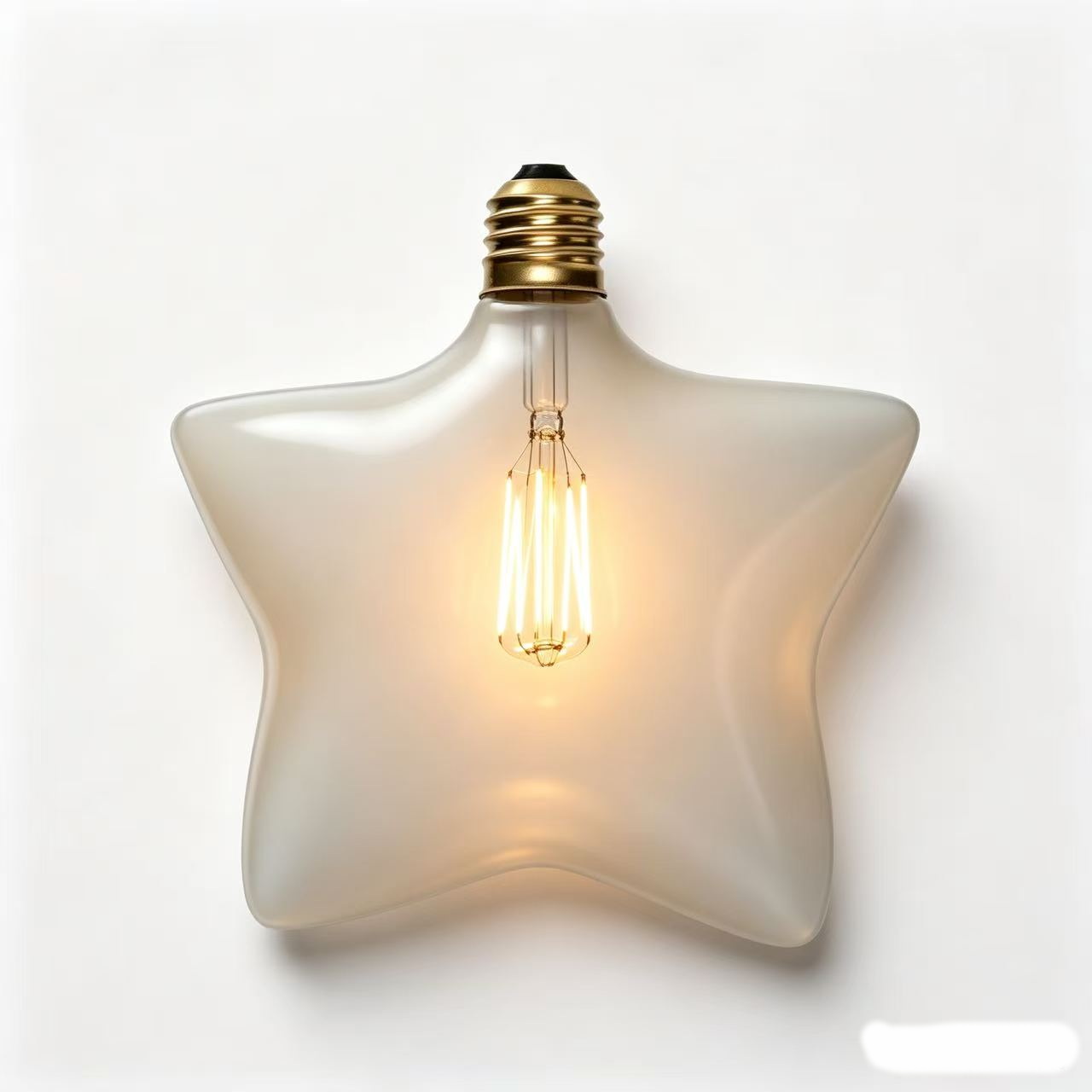
Unique star-shaped vintage LED filament bulb with milky white frosted glass, E27 base, warm 2200K-2700K glow. Perfect decor bulb for pendant lights, cafe, home ambient lighting & holiday decoration.

Amber Soda Can Shaped Edison Decorative Bulb, E27 Retro Art Lamp

G150 large globe decorative bulb with double spiral filament & amber glass. Classic Edison vintage style, perfect for pendant lights, cafe, loft & home antique decoration.